Barefoot Resurrection

A boy was teaching a girl Spanish badly in a coffee shop, letting her correct every other word, and I was weeping in a leather chair, my back turned so they wouldn’t see.
“I wanna hear all about that,” he said to something she’d mentioned, and my heart cracked open.
It wasn’t the words exactly. It was the way he said them—innocent, unguarded, genuinely curious. No performance. No trap. Just: I’m interested in you. The girl was shy, tentative, and he was drawing her out with chess and terrible Spanish pronunciation and the kind of sweetness I didn’t know existed when I was her age.
I’d come to the cafe because I couldn’t work. A dear friend had driven off a mountain road on Friday, her car tumbling 150 feet into a ravine before lodging in trees that kept her from the cliff edge beyond. She and her dog had walked away mostly unharmed, but I couldn’t stop imagining the fall—that moment of knowing you’re going over, that certainty of a terrible ending.
All morning I’d been watching videos of tribal people in Pakistan responding to Western music, their faces so calm, so thoughtful, so present. I needed to see humans being gentle with each other. I needed evidence that tenderness still existed.
And then these two sat down behind me.
They had no idea I was there. When I got up to throw away my cup, I smiled at them, but they didn’t look away from each other. They were too amazed by their own unfolding, too delighted by the discovery that another person could be this interesting, this worthy of their undivided attention.
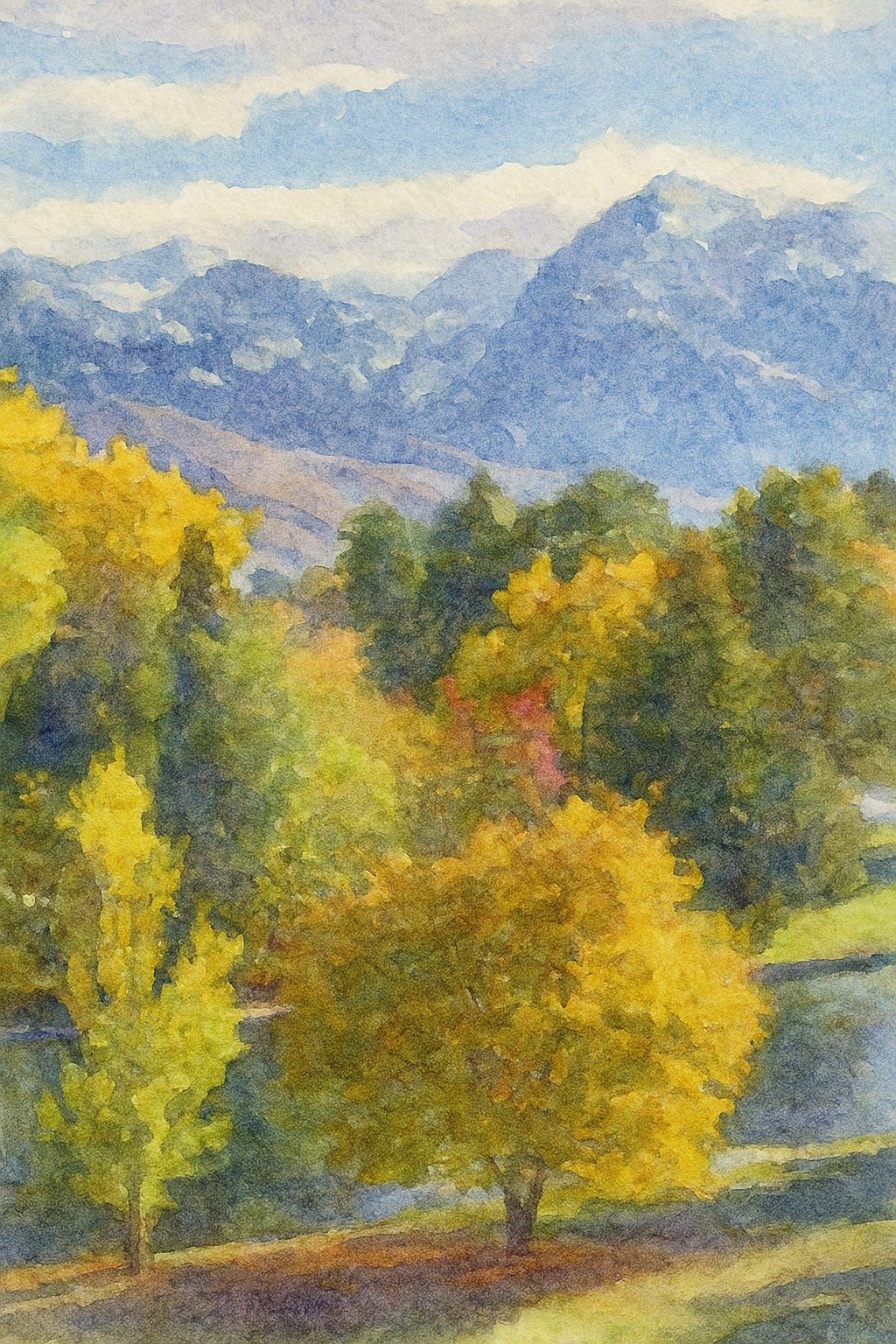
I walked out into the autumn morning. The sky had been gray all day, mountains hidden behind clouds. As I crossed the street toward the park, the clouds pulled back like a curtain, and suddenly the Wasatch appeared—white peaks sharp against October blue, watching over everything.
They were there all along, I thought. Just hidden.
I walked through the nature preserve that leads to the park. Golden leaves formed a tunnel overhead, the path carpeted in yellow. Light filtered through the canopy in that particular autumn way—honey-colored, making everything glow. It felt like walking through a threshold into a safer place.
At the edge, there’s an odd formation—red rocks stacked in sculptural arrangement between the wild hollow and the manicured park. Human-made. An attempt to bring wilderness into the urban without letting it actually be wild. I passed through this strange border country and emerged at the pond.
One tree blazed golden on the far shore, and the still water held its reflection so perfectly I couldn’t tell where the tree ended and the image began. Sky and depth. Surface and underneath. Both true at once.
I was drawn to it the way we’re drawn to altars. I sat on a bench facing the water, let the sun touch my face for the first time in days, and opened my book—a story about two young women learning to trust their own voices, their own ways of knowing.
The grass was still damp from morning rain. When I finally stood to walk the path around the park, I felt the soft, wet ground give slightly under my barefoot shoes—those thin-soled things that let you feel every pebble, every texture, every conversation the earth wants to have with your feet.
This is how it should feel, my body said. This is the gentle way. This is how you’re meant to walk through life.
Not on pavement. Not armored. Not separated from what holds you.
I passed a sports team crawling up a steep hill on their hands and knees, their coach shouting encouragement. The path curved along a stream, water moving over rocks in that eternal autumn brightness—gold leaves floating on the surface, catching light.
That’s when I saw the sign.
It was partially submerged in the stream, lodged against rocks: “Scott’s Celebration of Life.” Someone had held a memorial here over the weekend, and the sign had blown or fallen into the water.
Mine too, I thought.
I don’t know who Scott was. But I understood that this whole day—the couple at the cafe, the sun breaking through clouds, the mountains appearing, the soft ground under my feet—this was my celebration of life. My friend had survived her fall. I had survived the morning’s anxiety. We were still here.
I looked at the steep concrete embankment leading down to the stream. It was maybe fifteen feet, sloped at an angle that would be manageable going down but tricky coming back up. The sign needed to be retrieved. It didn’t belong in the water.
I picked my way down carefully, retrieved the sign from the water, and turned to climb back up.
That’s when my feet went out from under me.
One moment I was upright, the next I was sliding backward toward the freezing water, concrete scraping under me, my thin barefoot shoes peeling off my feet and bouncing down the slope ahead of me toward the stream.
Not like this, I thought, scrabbling for purchase, hands reaching for anything solid.
And then—my bare feet found the earth. Skin on concrete, toes gripping rocks, and somehow I caught myself. Stopped the slide. My shoes lay at the bottom near the water’s edge, and I was suspended on the slope, barefoot, breathing hard, the sign still clutched in one hand.
I couldn’t go straight up—too steep, too slick. So, I traversed sideways on bare feet, feeling every inch of cold concrete, until I found a less vertical section. Grabbed my shoes. Scrambled up to level ground.
And then I laughed.
Not nervous laughter. Not relief, exactly. Just—the pure absurdity of it. The way life keeps teaching you the same lesson in different languages until you finally understand.
I walked to the nearest trash can, disposed of Scott’s sign with something like reverence, put my shoes back on, and kept walking.
It wasn’t until I was halfway around the park, adrenaline still humming pleasantly through my body, that I understood what had just happened.
I had felt what my friend felt.
That moment of going over—unexpected, out of control, the certainty of a harsh ending. The way time stretches when you’re falling, when your body knows something terrible is coming, and there’s nothing you can do but fall.
And then: caught.
Not by my own strength or skill. By the earth itself. By friction, texture, and the way bare skin grips concrete better than rubber soles, when gravity works differently than I expected.
My friend went 150 feet down a mountain, and trees caught her. I went fifteen feet down an embankment, and the ground caught me.
We both lost our footing as we tried to move through the world. We both thought we’d end up in the cold. We both discovered that sometimes there’s something soft enough to hold us when we fall.
I would have laughed even if I’d landed in the stream. Even soaking wet, walking a mile home in freezing clothes, I would have laughed when I told the story later because I would have been alive to tell it. Ridiculous and cold and alive.
But I didn’t have to get wet. The earth caught me with my clothes still dry, my dignity mostly intact, just my pride scraped a little from the scrambling.
This is what resurrection looks like in real life. Not glowing and transcendent. Barefoot, muddy, and laughing at yourself.
I walked back through the nature preserve on my way home, and the same golden tunnel I’d passed through earlier. The leaves were still bright, the path still carpeted in yellow, the light still slanting through in honey-colored shafts.
But I was different.
I’d left my apartment that morning, unable to work, unable to focus, carrying my friend’s fall in my body. I’d needed strangers on the internet to show me that humans could still be gentle. I’d needed a boy speaking Spanish badly to prove that tenderness wasn’t extinct.
I’d needed the soft, wet ground to teach my body a different way of walking.
And then I’d needed to fall—just a little, just enough—to understand that being caught isn’t about deserving it or being strong enough or making all the right choices. Sometimes you slip while trying to do something good, and the earth holds you anyway.
My friend didn’t deserve to go off that road. She also didn’t deserve to be caught by trees. It wasn’t about deserving. It was about the fundamental fact that sometimes, when we’re falling, the world is soft enough to catch us.
Not always. Not for everyone. The world breaks plenty of people who deserve better.
But sometimes, on an October morning when the mountains appear after being hidden by grey clouds, a boy says “I wanna hear all about that” to a shy girl, the pond reflects both sky and depth at once, and your bare feet find purchase on a concrete slope. Sometimes there’s grace.
What I’m learning about barefoot resurrection is that it requires taking off the armor, feeling the wet ground, and being willing to go down steep embankments to retrieve what’s been lost or forgotten. It takes being willing to slip, scramble, and climb back up with scraped hands and muddy feet.
It takes being willing to laugh when you thought you’d cry.
The trees that caught my friend and the ground that grabbed me didn’t ask if we were strong enough first. They didn’t wait for us to deserve it. They were just there, doing what earth does: holding what falls toward it, offering resistance that feels like grace, catching us with bark and soil and friction we didn’t know we could count on.
I made it home after my partner got back from the doctor. I had a hug ready for him, prepared to be held and to tell the story of my small, ridiculous resurrection.
I was ready to be soft enough to let someone catch me after my fall.